
The Heartbeat behind Strong Mental Health Initiatives
it’s the people who have fun working in a company that make such an organization a success and not only the profits or performance that the organization gets. Employee well-being has come into being as the backbone of modern business strategy rather than a mere corporate buzzword.
Mental health is now seen by companies as a factor that is interlinked with productivity, even fuelling it. Through a healthy mind, one gets to be an employee full of energy, good cooperation, and even better results. The investment in well-being is an example of organizations providing direct support to their workers as well as their own future security.
The Shift from Wellness to Well-Being
Workplaces for many years were mainly concerned with health in the form of physical activities like yoga, gym, or providing non-fatty snacks at the counters. These are all good, but true employee welfare is a lot more to it. It is the provision of different kinds of balances, such as emotional, mental, and psychological, for every worker.
The holistic approach looks to fitness to the extent of feeling the employees the way they think about their work, the environment, and themselves. Well-being is not about stopping diseases; it is about providing the necessary conditions for people to flourish.
Why Employee Well-Being and Mental Health Are Essential Partners
Theoretically, a workplace filled with inspired, assured, and stable individuals comes to mind. Stress is less, conflicts are reduced, and there is more cooperation. This is what occurs when mental health and well-being intersect.
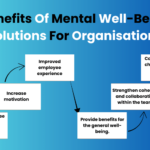
If firms make it a point to fully support mental health, the employees will be beneficiaries of:
- Decreased stress levels
- Increased clarity and creativity
- More contentment with their jobs
- Better relationships and trust among co-workers
In brief, well-being is the ground of the pyramid, and mental health is the apex that rises high on it.
In what ways Employee Well-Being bolsters Mental Health programs
1. Establishing a Norm of Transparency: Mental health is very much alive in environments of open, non-judgmental, and understanding discussions. Leaders who are frank about stress, burnout, or work-life balance not only support employee mental health but also build a community where the workers feel their presence and idea are important.
2. Disburse Emotional Support Machinery: EAPs, therapy sessions, and peer-support groups are available for employees to resort to whenever they feel like they need help. These services are the ones that create culture that is built on caring making well-being a matter of shared responsibility.
3. Work-Life Balance Promotion: Employee burnout is lessened and their happy faces are more on company time when flexible working hours, telecommuting, and fair deadlines are offered. The firms that emphasize boundaries create an environment for the workers which are healthier and more sustainable for the whole company.
4. Empathy-Based Leadership Training for Managers: The managers are the ones who mainly influence the organizational mental health. If they are trained to spot the first signs of stress and to have a kind approach in their dialogues, the staff will feel supported not criticized.
5. Support in Mistakes and Acknowledgement of Success: Health is not only about having a relaxing time; it is also about having a feeling of purpose. Recognition of achievements, support for learning, and giving promotion opportunities uplift the self-image and great mental attitude.
Real-World Examples of Employee Well-Being Success
Businesses all over the planet are confirming that a well-being-centric approach is a lucrative one.
Google devotes a lot of money to mental wellness programs, meditation areas, and resilience training which in turn leads to employees who are more satisfied and imaginative.
The Indian outsourcing giants TCS and Infosys have gone one step further to their employees’ mental health by introducing emotional wellness platforms and virtual counselling.
Microsoft’s policy gives employees the opportunity to work from home and take “wellness days” to recuperate mentally regularly. Not only do these firms provide the wellness activities, but they also practice them as part of their daily regulations.
The Business Case for Mental Health: It’s not only humanity; it is also a business opportunity. Different studies have concluded that for every ₹1 put into mental health programs, ₹4 would be the return for the company by way of productivity, engagement, and retention.
The employees feeling supported in their minds take less sick leaves, communicate more effectively, and stay longer. To sum up, well-being is the main driver of performance emotional as well as financial.
Building a Future Where Well-Being Comes First: The future office will not only be rated on profit margins but also on the scale of happiness, resilience, and balance.
Mental health investments in today’s organizations will result in stronger, more loyal, and burning-out-ready workforces that can face challenges without stress. A firm that places a high value on well-being not only communicates to its employees: You matter, through actions, but also words. And when people are aware that they are valued, they will put in their best effort not because they are obliged, but because it is their desire.
Final Thoughts: No longer something to be handled in a parallel way, employee well-being becomes the core of contemporary HR strategy. It is the factor that ensures healthy thinking, strong connection between teams, and the flourishing of enterprises.
Where there are genuine care, flexible policies, and empathetic leadership, mental health initiatives of the companies will get strengthened, and they will not only create good workers but also a bright future
Ultimately, well-being is not about just being fine it is about being inspired, supported, and strong.